
Single Stage End Suction Pump vs. Double Suction Pump: How to Choose the Right One
Procurement teams and site engineers run into the same fork in the road constantly: the flow and head numbers are already locked in, the budget has a ceiling, and now someone has to pick between a single stage end suction pump and a single stage double suction pump. Both belong to Longshine’s Cummins diesel water pump set lineup, and on paper, both get the water where it needs to go. The real differences show up in how they get there, and how well they hold up once they’re doing it day after day.
Below is a breakdown of what actually separates the two, where each one earns its place on a job site, and how to land on the right configuration based on your operating conditions instead of whichever pump happens to be sitting at the top of a supplier’s catalog.
What Is a Single Stage End Suction Pump
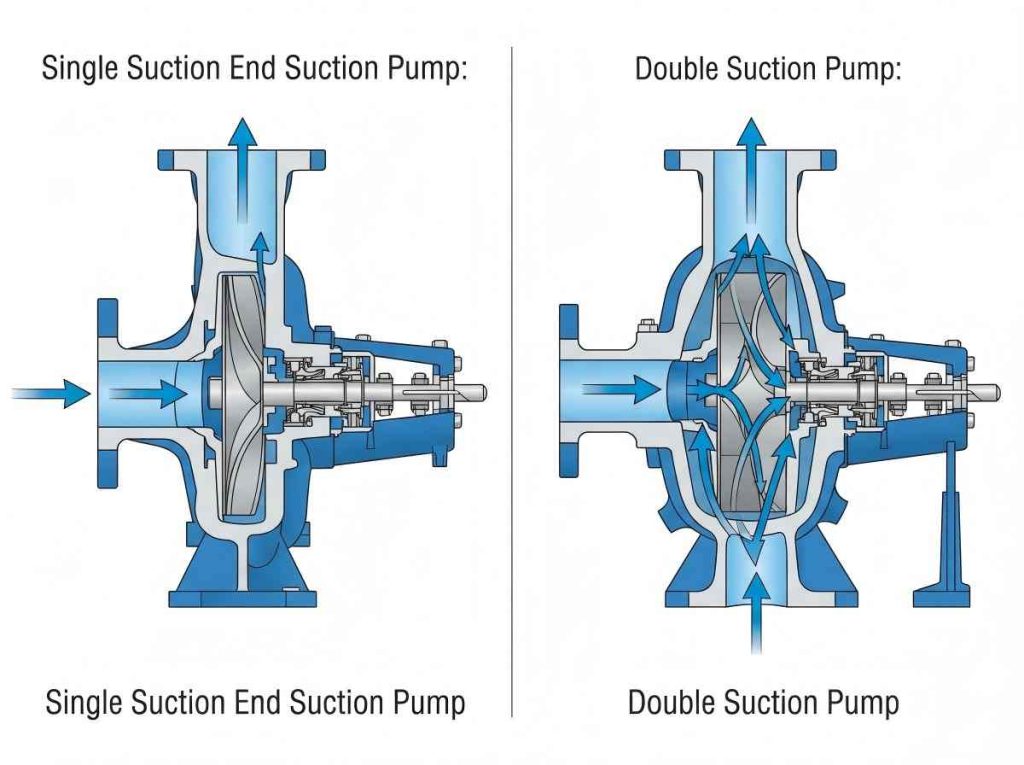
An end suction pump runs on a single impeller, with water entering from one side only, drawn in horizontally and pushed out radially through the top or side discharge. The design is suspended, or cantilevered, so the rotor and shaft can be pulled straight out for service without touching the inlet and outlet piping. Anyone who’s had to shut down a line for a routine bearing swap knows what a difference that makes.
The catch with a single inlet is that water pushes against the impeller unevenly, creating axial thrust that the bearings have to absorb. In most applications this isn’t something to worry about, but push a pump hard enough, long enough, and that uneven load starts wearing bearings down faster than you’d see in a balanced design.
Day to day, though, this is usually the pump people reach for first. Fewer moving parts means lower cost and less guesswork when something needs fixing, and the compact frame fits into pump rooms where space is already tight.
What Is a Double Suction Pump
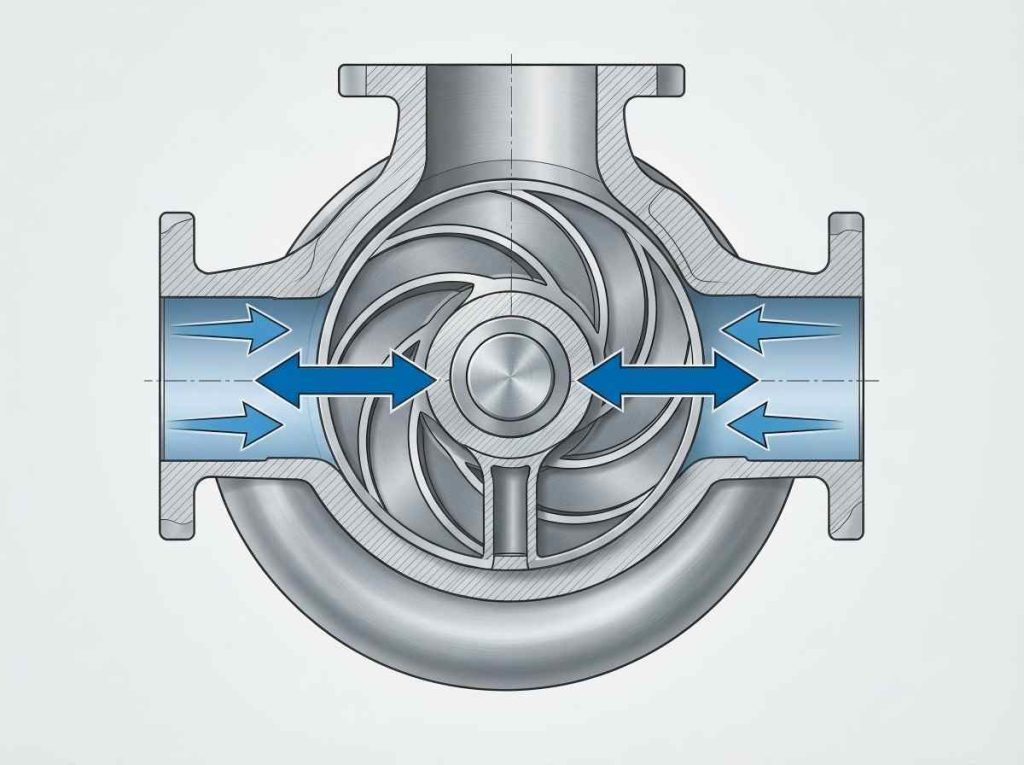
A double suction pump works off the same core principle, just doubled. Water enters the impeller from both sides at once, essentially two single suction impellers mounted back to back, with everything merging into one volute casing. Because the inflow is split evenly, the axial thrust that single suction pumps have to fight against basically cancels itself out.
The payoff shows up in how the pump runs: smoother, quieter, and far less prone to cavitation once flow demands start climbing. Most double suction casings also split horizontally down the middle, so a technician can crack it open for inspection without disconnecting it from the piping at all.
None of this comes for free, though. These pumps are bigger, cost more to buy, and take more thought during installation planning. What you get back is a pump that can push considerably more water at the same impeller diameter, and one that generally outlasts a single suction design under continuous, heavy-duty conditions.
Single Suction vs. Double Suction Pump: Key Differences
| Factor | Single Stage End Suction | Double Suction |
| Water inlet | One side | Both sides, symmetrically |
| Axial thrust | Higher, more bearing load | Balanced, minimal load |
| Flow range | Low to moderate | High |
| Cavitation resistance | Standard | Stronger |
| Upfront cost | Lower | Higher |
| Long-term durability | Solid for moderate duty | Better suited to continuous heavy use |
| Footprint | Compact | Larger, needs more layout planning |
| Maintenance access | Cantilevered design, easy rotor pull | Horizontally split casing, straightforward inspection |
How to Choose Between a Single Suction and Double Suction Pump
Picking between the two comes down to a handful of factors tied to your specific site and workload, not a fixed rule. Here’s what actually moves the needle.
Flow Rate and Head Requirements
Flow is where most people start narrowing things down. Single suction pumps cover low to moderate flow rates without issue, but push past that into high-volume territory and you’re stuck either oversizing the inlet and outlet or keeping the speed low enough to avoid chewing through bearings. Splitting the inlet on a double suction pump gets around that problem entirely, since the pump can move more water without the same mechanical strain. If your flow requirement sits near the top end of what a given pump series can handle, that’s usually the point where a double suction model makes more sense.
Continuous Duty vs. Intermittent Use
How often the pump runs matters just as much as how much water it’s moving. A pump cycling on and off for irrigation or general cooling wears differently than one running nonstop in a municipal water system or a power plant cooling loop. Run it continuously under heavy load, and the balanced thrust on a double suction design starts to show its value in fewer bearing replacements and less downtime. For anything intermittent or moderate, an end suction pump holds up just fine and costs less to own.
Budget and Total Cost of Ownership
Purchase price and lifetime cost don’t always point the same direction. An end suction pump costs less upfront and is cheaper to keep running, which is usually enough reason on its own for smaller projects or tighter budgets. A double suction pump costs more to buy, but in continuous, high-flow settings that gap tends to close over a few years, mostly through fewer bearing replacements and less unplanned downtime. For a pump that’s going to run near full capacity for the long haul, it’s worth pricing both options out over five or ten years instead of just looking at the quote in front of you.
Installation Space and Piping Layout
Double suction pumps take up more room, plain and simple, and the piping, foundation work, and maintenance clearance all need more planning around them. On a site where the pump room is already cramped, that extra footprint can become a real problem. End suction pumps are compact enough to slot into tighter spaces without much fuss.
Cavitation Risk and Suction Conditions
Long suction lines, elevation changes, marginal net positive suction head — any of these push suction conditions into territory where a double suction pump’s cavitation resistance actually matters. Cavitation wears down an impeller gradually, and performance can drop off before anyone notices what’s causing it. It’s the kind of problem that’s cheap to prevent and expensive to fix once it’s already eaten into the metal.
Typical Applications by Pump Type
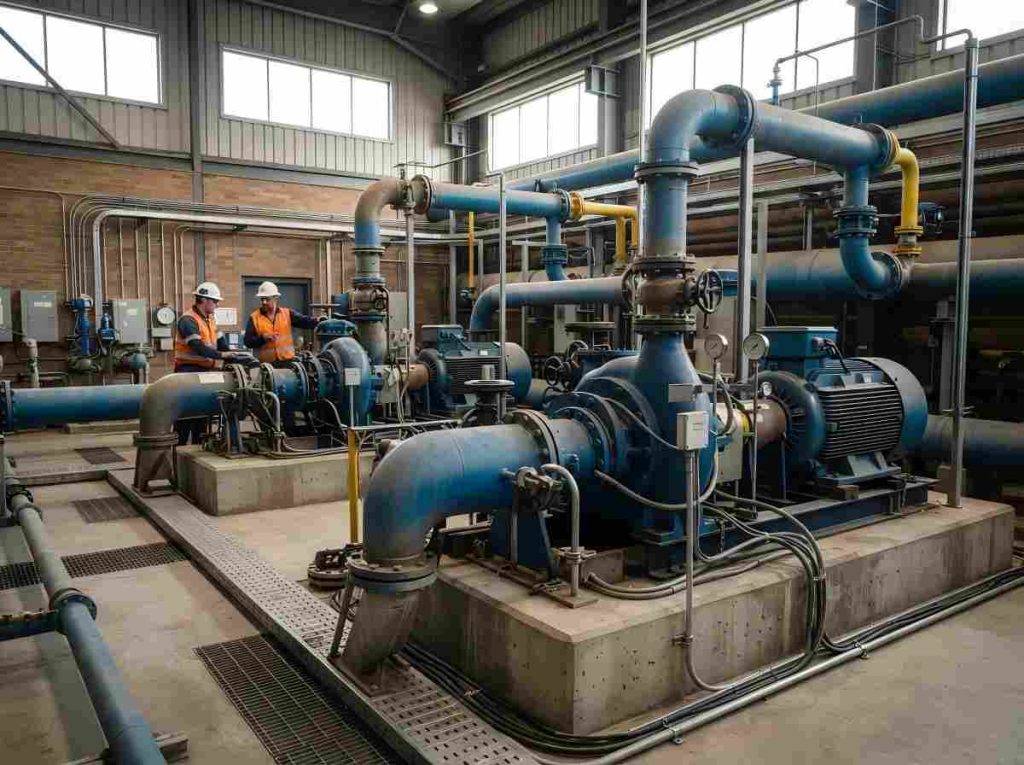
Single stage end suction pumps show up most often in:
- General industrial circulating water systems
- Small to mid-sized fire protection supply
- Agricultural irrigation
- Smaller construction and facility water supply projects
Double suction pumps get pulled in for bigger jobs, things like:
- Municipal water supply and drainage systems
- Power plant and chemical plant cooling circuits
- Large-scale fire protection systems
- Mining dewatering operations
- High-volume water transfer projects
Get the pump type right for how the site actually operates, and it’ll run quietly in the background for years. Get it wrong, and it turns into the thing your maintenance team keeps circling back to. If you’re working through flow, head, or duty-cycle numbers for a specific project, reach out to our team with your parameters and we’ll help you land on the right configuration from our Cummins diesel water pump set range.
FAQ
Is a double suction pump always more expensive than an end suction pump?
Upfront, yes — expect to pay more for a double suction unit at a comparable duty point. But that gap doesn’t always hold up over time. In continuous, high-flow applications, fewer bearing replacements and less downtime can close the difference, sometimes enough to make the double suction pump the cheaper option in the long run.
Can both pump types be paired with a Cummins diesel engine?
Yes, both configurations work fine with diesel engine drives, and this is common for mobile, backup, or off-grid setups in agriculture, construction, and emergency dewatering work.
Is there a flow rate where it makes sense to switch from single to double suction?
No single number works across every industry, but once flow demands push a single suction impeller toward the edge of what it can handle without oversizing the diameter or cutting speed, that’s usually the signal to look at double suction instead. Where exactly that line sits depends on the pump series, so it’s worth walking through your actual project numbers with a supplier rather than guessing.
Which type requires less maintenance over time?
Day-to-day servicing is quicker on an end suction pump simply because there’s less to take apart. Double suction pumps ask for less frequent bearing and seal work in continuous-duty settings, thanks to the balanced thrust, even if each visit takes a little longer given the larger casing involved.