
Cummins X15: Power, Torque and Everything You Should Know
In the fields of heavy-duty trucking and specialized transport, the Cummins X15 diesel engine is widely used in Class 8 heavy trucks, construction machinery, and long-haul transport due to its outstanding fuel efficiency, exceptional reliability, and powerful performance. Whether you are a fleet manager, a service technician, or a truck owner, gaining a deep understanding of the X15’s performance specifications, common failures, and maintenance key points is essential for lowering total cost of ownership (TCO) and extending engine life.
This article provides a comprehensive overview of the Cummins X15 series differences, technical specifications, and maintenance guidelines to help you make more precise selection and procurement decisions. Let’s go!
What is the Cummins X15 Engine?
The Cummins X15 is a heavy-duty diesel engine platform under Cummins, featuring an actual displacement of approximately 14.9 L and an in-line 6-cylinder architecture.
Depending on the version, the X15 offers different horsepower and torque configurations. For instance, the 2024 X15 Efficiency Series delivers a horsepower range of 400–500 hp with torque between 1,450–1,850 lb-ft, while the 2024 X15 Performance Series provides 525–565 hp and up to 2,050 lb-ft of torque.
The X15 is not designed simply as a single “high-horsepower engine.” Cummins offers different series—including Efficiency, Performance, and Productivity—tailored to various transport and operational demands, allowing the engine to match long-haul, heavy-haul, and vocational applications.

Cummins X15 Specifications
Because specs vary across different X15 versions, the following data should serve as a reference for different product series rather than a uniform specification for all X15 engines.
| Item | Cummins X15 Reference Information |
| Engine Type | Heavy-duty diesel engine |
| Displacement | Approx. 14.9 L |
| Cylinder Count | 6 cylinders |
| Horsepower | 400–605 hp, varies by series and ratings |
| Torque | 1,450–2,050 lb-ft, varies by series and ratings |
| 2024 Efficiency Series | 400–500 hp / 1,450–1,850 lb-ft |
| 2024 Performance Series | 525–565 hp / 1,850–2,050 lb-ft |
| 2024 Productivity Series | 430–605 hp |
| Stage V X15 | 450–675 hp / 1,600–2,050 lb-ft |
| Typical Applications | Heavy-duty trucks, long-haul transport, heavy-haul, and vocational vehicles |
How Much Horsepower Does the Cummins X15 Have?
This is a very common query while looking up for the Cummins X15.
Horsepower in case of the Cummins X15 engines is not a constant value. The exact number will vary with respect to the engine type, ratings, emissions, and application markets.
Some of the ranges of horsepower values available in recent product catalogs are:
- X15 Efficiency Series 2024: 400–500 hp
- X15 Performance Series 2024: 525–565 hp
- X15 Productivity Series 2024: 430–605 hp
- Select Stage V X15: 450–675 hp
How Much Torque Does the Cummins X15 Have?
Similarly, torque is not identical across all Cummins X15 engines.
The 2024 X15 Efficiency Series features a peak torque range of 1,450–1,850 lb-ft (approx. 1,966–2,508 N·m). The 2024 X15 Performance Series reaches peak torque ratings of 1,850–2,050 lb-ft (approx. 2,508–2,779 N·m). Select Stage V X15 configurations can also achieve a peak torque of 2,050 lb-ft.
The relationship between torque and power production becomes significant for heavy trucks while launching, climbing, and under load conditions. However, when picking an engine, you cannot just consider the horsepower or torque, as there are other factors that need to be taken into account as well. These include gross vehicle weight (GVW), transmission, axle ratio, and more.
Major Cummins X15 Series
Cummins X15 engines come in various series depending on needs, horsepower ratings, and emissions requirements. Knowing the place occupied by each series will help users choose the right engine.
X15 Efficiency Series
This series is mainly intended for those applications that prioritize fuel efficiency and management of transport costs in long haul operations. For 2024, this series comes with horsepower ratings of 400-500 hp and torque of 1,450-1,850 lb-ft to meet EPA emissions standards for 2024. There are SmartTorque and EX versions to match different powertrain systems. Selection of this series for long-haul trucks is a matter of matching horsepower and torque with the load and transmission.
X15 Performance Series
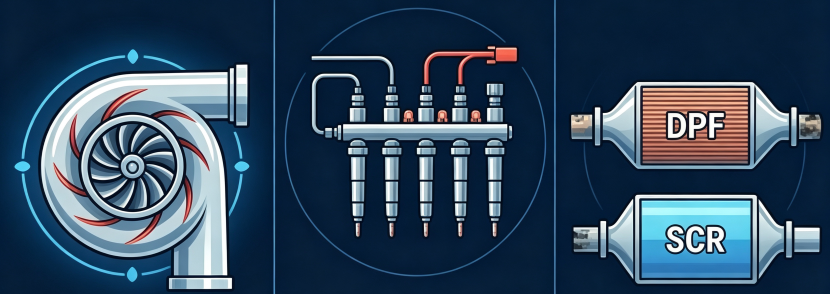
Focuses on higher power output. The 2024 version delivers ratings of 525–565 hp and peak torque up to 2,050 lb-ft, making it ideal for premium long-haul, heavy-haul, and applications requiring high power reserves. It utilizes VGT turbochargers, XPI fuel systems, and Single-Module aftertreatment systems.
X15 Productivity Series
Tailored for vocational vehicles and high-load duty cycles. 2024 product specs show ratings from 430–605 hp with peak torque up to 2,050 lb-ft. These vehicles frequently encounter frequent start-stop cycles, heavier payloads, or tough working environments, so selection should be based on vehicle duty cycle, load profile, and powertrain specs.
Key Technical Features of Cummins X15
XPI High-Pressure Fuel System
Used high pressure fuel injection system along with multi injections per cycle in order to optimize the combustion process, making sure that the engine maintains constant power and fuel economy at all times.
VGT Turbocharger
The VGT type of turbocharger is installed in some models of X15 engine. This type of turbocharger regulates the boost characteristics depending upon the engine speed and load.
Electronic Control System
Equipped with a powerful Electronic Control Module (ECM), controlling the air, fuel and other systems of the engine. It allows to make diagnostics, monitoring and troubleshooting of the engine.
Aftertreatment System
Configured according to model year and emission standards. For example, the 2024 X15 uses a Single-Module Aftertreatment System, while the next-generation 2027 X15 introduces a new aftertreatment architecture. Therefore, when procuring or replacing aftertreatment parts, simply stating “Cummins X15” is insufficient; you must verify the specific engine model, year, emission standard, and Engine Serial Number (ESN).
Application Areas of Cummins X15
Heavy-Duty Trucks: These are extensively used in heavy duty trucks when long distance haulage and high gradeability haulage is required.
Long-Haul Transport: For line haul operations, the engine should be capable to fulfill requirements of continuous running, economy, gradeability, and long time maintenance. Efficiency and Performance series can be used for such purposes.
Heavy-Haul Transport: Requires higher power and torque outputs. Select configurations of the X15 Performance Series reach up to 565 hp and 2,050 lb-ft, ideal for heavy transport tasks demanding power reserves.
Vocational Vehicles: Applied in vocational trucks including construction vehicles, specialized trucks, fire, and emergency vehicles. Configurations are selected based on specific vehicle operational environments.
Common Failures Analysis & Maintenance Tips of X15 Cummins
Even high-durability diesel engines require preventive maintenance under prolonged heavy loads and harsh conditions. Based on field service experience and fleet feedback, here are the most common X15 fault risks and maintenance recommendations:
1. VGT™ Turbocharger & Electronic Actuator Faults
Symptoms: Slow engine acceleration, low engine power during heavy loads, low engine braking performance, or VGT actuator position/fault codes appearing on the control panel (for example, Cummins fault code 2357 or 2636).
Cause Analysis: Prolonged operation at low RPMs, short trips, and poor fuel combustion result in excessive carbon depositing on the VGT nozzles and vanes that leads to mechanical lock up. As a result, the internal gears of the actuator get overheated and burn out.
Maintenance & Troubleshooting:
Routine Maintenance: Avoid unnecessary extended idle time and check the EGR system for any blockages that may cause carbon build-up in the intake manifold.
Troubleshooting: Perform a VGT Sweep Test through diagnostic software to determine if the failure is due to the electronic actuator or vanes stuck mechanically. If mechanical movement is smooth, replace only the OEM VGT actuator and perform recalibration. If the internal mechanism is severely seized, clean or replace the complete turbocharger assembly.
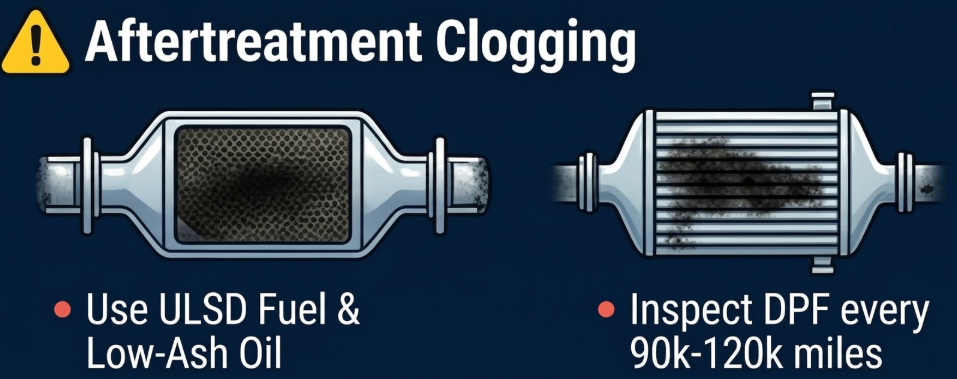
2. EGR & DPF Aftertreatment Clogging & Frequent Regeneration
Symptoms: Significantly higher DPF (Diesel Particulate Filter) active regeneration occurrence, excessive engine back pressure, unusual fuel consumption increase, or engine power derate due to excess engine back pressure.
Cause Analysis: Use of low quality diesel fuel (sulfur-rich fuel), engine oil burning, or leaking of the XPI injectors result in incomplete combustion of the fuel. The unburnt particles and ash accumulate very fast in the honeycomb core of the DPF, and carbon accumulates in the EGR cooler.
Maintenance & Troubleshooting:
Fuel/Oil Control: Strictly use Ultra-Low Sulfur Diesel (ULSD) and low-ash (CJ-4 / CK-4) heavy-duty engine oil.
Inspection Interval: Remove the DPF every 150,000 to 200,000 km (approx. 90,000–120,000 miles) for thermal baking and pneumatic ash cleaning. Periodically check EGR valve movement and EGR cooler pressure differential to prevent coolant leaks from contaminating the aftertreatment system.
3. XPI High-Pressure Common Rail Fuel System Wear & Injector Faults
Symptoms: Difficult cold starting, intense idling vibration, too much black exhaust smoke while under load, inability to generate fuel pressure, or engine knock noise.
Cause Analysis: The XPI system runs at very high pressures of more than 2,600 bar; therefore, it is very sensitive to the quality of the fuel in terms of lubricity and purity. Moisture and other contaminates in the fuel cause abrasion of injectors and other fuel pump components.
Maintenance & Troubleshooting:
Filter Maintenance: Replace high-efficiency fuel-water separators and primary fuel filters according to prescribed service schedules. Never use low-quality non-OEM replacement filter elements.
Troubleshooting: Perform cylinder cutout tests and high-pressure common rail leak-down tests via diagnostic tools to locate failing cylinders or pressure leaks. When replacing fuel injectors, always code the new IMA (Injector Quantity Adjustment) parameters into the ECM to ensure balanced fuel delivery across all cylinders.
How to Choose a Cummins X15 Engine
For those looking to buy a Cummins X15 engine or a replacement engine for Cummins X15, just saying “X15” is not going to work. Below are some steps to be taken before making your purchase:
Confirm Engine Series and Ratings:
This will determine the series that is needed (Efficiency, Performance, or Productivity), matching the ratings of horsepower and torque.
Confirm Engine Serial Number (ESN):
This gives all the exact information about the engine. Always give the ESN while buying engines or their spare parts.
Confirm Emission Standards:
Identify local emissions requirements (EPA, EPA 2024, Tier 4 Final, Stage V, Euro standards, etc.) to ensure proper engine and aftertreatment compatibility.
Confirm Vehicle Application:
Clearly identify the vehicle type (Heavy-duty truck, Long-haul truck, Heavy-haul truck, Vocational truck, or Fire/Emergency vehicle).
Confirm Part Numbers:
For Cummins X15 replacement parts, provide exact Part Numbers alongside the ESN to prevent compatibility issues caused by production year variations.
Conclusion: Know Your Specs Before You Buy
The Cummins X15 is a dynamic 15-liter diesel engine platform series, including different series, different emission standards, and different application scenarios, rather than a specific engine.
In your inquiry for a Cummins X15 engine, replacement engine, or parts, you should give your engine model, engine serial number, part numbers, and vehicle model.
Longshine provides sourcing and supply support for customers requiring Cummins Engines and Parts, assisting in product verification based on engine models, part numbers, and specific application requirements.