
How to Choose and Buy Cummins Engine Turbocharger?
With the rapid development of the global logistics transportation, mining machinery, marine propulsion, and power generation industries, Cummins engines have become the preferred powertrain for numerous sectors due to their exceptional power performance and reliability. In the efficient operation of a Cummins engine, the turbocharger plays a critically vital role.
Whether it is the Cummins X15 in heavy-duty trucks, the QSX15 in mining equipment, or the K19 and K38 engines in the marine propulsion sector, the turbocharger directly impacts engine power output, fuel economy, and emissions performance.
What exactly is a turbocharger for a Cummins engine? How does it work? How do you select the right Cummins engine turbocharger, and how do you diagnose and maintain it when a fault occurs? This comprehensive article provides a detailed breakdown.
What is a Cummins Engine Turbocharger and How Does It Work?
Cummins engine turbochargers refer to highly engineered devices whose main aim is to force feed air into the engine cylinders. The ultimate objective of a turbocharger is to enhance the density of the incoming air into the cylinders, thus helping the engine burn more fuel for more power production.

Work Principle of Cummins Engine Turbocharger
Turbochargers function using the heat energy available in exhaust gases, which are not used and would escape into the atmosphere via the exhaust pipe:
Turbine Section: High-pressure exhaust gases coming out from the exhaust manifold of an engine move into the turbine section where they force the turbine wheel to spin at very high speeds, around 100,000 to 150,000 RPM.
Axially Connected: The turbine wheel is fixed to the compressor wheel, which is mounted on the other end, using a highly durable and strong steel shaft.
Compressor Section: The rotation of the shaft causes the compressor wheel to suck in air that is already filtered by an air cleaner and compress it into the intake manifold.
Intercooler Cooling Process: When air is compressed, its temperature increases, resulting in a decrease in its density. Thus, it must cool down through a Charge Air Cooler (CAC) before entering the cylinders to ensure optimal density of oxygen for optimum combustion.
Why Are Cummins Engines Universally Equipped with Turbochargers?
Through its specialized brand, Holset, Cummins has deeply integrated advanced turbocharging technology into its product lines. This approach offers several core advantages:
Improved Power to Weight Ratio:
Through turbocharger technology, smaller displacement engines (for example, the Cummins 6.7L) will be able to achieve the power of conventional naturally-aspirated big-displacement engines, making the whole vehicle lighter.
Stringent Environmental Emission Requirements:
Current worldwide emission regulations (Euro VI/ present day EPA standards) set stringent requirements for particulate matter and NOx. Increased oxygen supply through the engine will help ensure complete combustion of the fuel and will work in tandem with EGR systems.
Reduced Fuel Consumption and TCO of Commercial Vehicles:
The use of turbochargers ensures that there is energy recovery in exhaust gases. This means that the engine becomes very efficient in terms of fuel economy; therefore, commercial vehicles reduce their fuel consumption per hour (GPH).
Altitude Compensation:
Operating in high altitude regions such as plateaus and high-altitude mines reduces engine power output due to low air density. Turbochargers overcome this problem by forcibly compressing the low-density air in order for Cummins engines to have full power output capability.
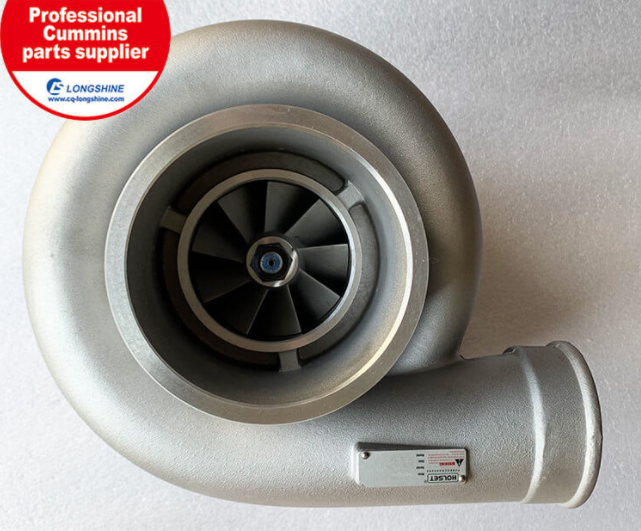
Common Cummins Engine Models Equipped with Turbochargers
Although today’s Cummins commercial diesel engines are all turbocharged, the most popular engine variants in terms of B2B purchasing, international aftermarket sales, and repair services include the following:
Light/Medium Duty and Pickup Power Series (Cummins 2.8L / 3.8L / 4.5L / 6.7L / ISB)
6.7L / ISB / QSB: Without a doubt, one of the toughest engines that can ever be used in a medium-duty truck, bus, or construction equipment, and even in pickup trucks such as the famous Ram 2500 & 3500 models. VGT Turbochargers, like the famous Holset HE351VE, find a lot of applications due to their immense popularity.
F2.8 / F3.8 / B4.5: These engines are extensively used in small trucks, excavators and forklifts and are hence quite popular nowadays.
Medium-Duty & Vocational Power Series (Cummins L9 / ISL / ISC)
L9 / ISL: An extremely flexible “all-round” 9-liter engine used in transit buses, waste collection vehicles, cement mixers, and medium-duty tipper trucks.
ISC / QSC8.3: An 8.3-liter engine family with a huge global presence in construction equipment like excavators and wheel loaders as well as heavy trucks from an earlier generation.
HD Flagship Truck Power Family Series (Cummins ISX15 / X15 / M11 / ISM11)
ISX15 / X15: The best-selling power plant in North America and worldwide for Class 8 HD long-distance truckers. This product line utilizes high pressure VGT turbochargers (e.g., Holset HE500VG family line) because of its heavy towing load.
M11 / ISM11: Despite the presence of modern engines being available on new trucks, the ISM11/QSM11 is one of the most popular 11L HD engines that can be found on imported used HD trucks, port tractors, and heavy industrial construction machinery.
Heavy Duty Series for Large Off-Road Vehicles (Cummins X12 / QX15 / QSB7)
X12 / QX15 / M15: Designed specially for construction machinery that needs modern and efficient engines to meet the latest standards of emission control all around the world.
High Horsepower, High Displacement Power Series (Cummins KTA19 / KTA38 / KTA50 / QSK Series)
KTA19 / KTA38 / KTA50: Engines specially designed for use in marine propulsion, mining trucks and large generator sets. These engines usually come in the configuration of twin turbo or quad turbo.
QSK19 / QSK38 / QSK50 / QSK60: The electronically controlled upgrades to the KTA series, widely deployed in modern ultra-class mining trucks, large vessels, and critical mission power generation sets. These high-performance turbochargers command high technical complexity and premium market value.
Main Types of Cummins Engine Turbochargers
Cummins Turbo Technologies has developed three primary Holset turbocharger architectures tailored to different operating conditions:
| Turbocharger Type | Core Mechanics & Advantages | Primary Applications |
| VGT (Variable Geometry Turbocharger) | Utilizes internal sliding vanes to adjust exhaust gas flow. At low RPMs, vanes narrow the passage to eliminate turbo lag; at high RPMs, they open wide for maximum airflow. Also doubles as an exhaust brake. | Highway trucks (e.g., ISX15, 6.7L ISB) |
| Wastegate Turbocharger | Features a mechanical or pneumatic valve. When boost pressure hits a safe upper limit, the valve opens to bypass excess exhaust gas, preventing over-boosting engine damage. | Construction machinery, medium-duty commercial vehicles |
| Fixed Geometry Turbocharger | The traditional, most robust design with zero moving internal aerodynamic parts. Precision-engineered for peak efficiency at specific steady-state RPMs. | Marine propulsion, constant-speed gensets, large mining equipment |
Common Faults and Pain Points of Cummins Turbochargers
Even with extremely high manufacturing standards, when operating under long-term, extreme temperature, and high RPM operations, turbochargers invariably experience various mechanical issues:
VGT Actuator Failure
In the case of VGTs, either electronic or pneumatic actuation systems may malfunction due to extended exposure to thermal radiation, electrical shorts, or gear degradation, thereby making it impossible to regulate the vanes’ position, thus switching the engine to limp mode.
Carbon and Soot Baking
Excessive engine idling or operating under low load results in the accumulation of soot carbon in the turbine housing. As a result, soot buildup may jam the VGT sliding vane assembly, generating diagnostic trouble codes (DTCs).
Oil Contamination and Oil Starvation
As the turbocharger rotor assembly operates suspended on an extremely thin layer of lubricating engine oil, any delay in performing oil changes or plugging of the oil inlet line will cause the rotor to score the bearings, resulting in their total failure.
Foreign Object Damage (FOD)
As the rotor assembly is designed to operate at near-supersonic speed, any object, as minute as sand particles, drawn into the rotating assembly by an aging, torn air filter or broken intake piping would destroy the blades in seconds.
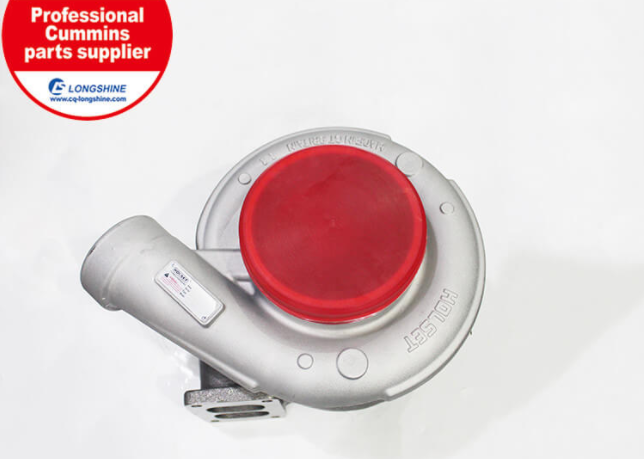
Critical Warning Signs That a Cummins Turbocharger Needs Replacement
Detecting turbocharger failure early prevents fractured metal fragments from being sucked backward into the engine cylinders, averting catastrophic engine failure. Fleet technicians should monitor closely for the following signals:
Sluggish Acceleration and Power Drop
The turbocharger fails to build boost pressure, resulting in insufficient air supply. The Engine Control Module (ECM) will automatically derate power output.
Unusual Exhaust Smoke
Blue or gray smoke signifies that there is a problem with the internal oil seals, leading to engine oil leakage on the hot exhaust or inlet side. Black smoke often results from an extreme fuel-to-air mixture discrepancy (not enough air intake).
Whining/Screeching Noise
Often described as a “siren-like noise,” this is caused by excessive clearance between turbocharger bearings such that the blades physically hit the housing.
Repeated ECM DTCs
Should fault codes like “Low Boost Pressure” or “VGT Actuator Error” keep appearing, then the turbocharger needs off-line testing.
How to Properly Select a Replacement Turbocharger?
In international trade and procurement, purchasing a replacement turbocharger requires high technical precision. Ordering based solely on broad engine models like “Cummins 6.7L” or “ISX15” often leads to incorrect parts.
Step 1: Identify the Holset / Cummins Nameplate Data
Every genuine turbocharger has a metal nameplate riveted to the compressor housing. Accurate procurement requires the following three core numbers:
Assembly Number (ASSY No.): The most critical manufacturing identification number.
Serial Number (S/N): The unique tracking number for that specific unit.
Customer/Cummins Part Number: The official OEM code found in the Cummins parts catalog.
Step 2: Define Your Sourcing and Budget Strategy
Genuine Holset / Cummins: Provides a perfect 1:1 fit, factory-calibrated actuators, and maximum longevity guarantees. This is the premier choice for high-compliance, high-uptime commercial fleets.
Top-notch OEM Specification Aftermarket: Crafted at Tier-1 manufacturing facilities based on original blueprints. This would be considered a very economical solution for out-of-warranty vehicles or construction equipment.
Remanufactured: Features the same high-quality cast iron housing as before but replaces all internal parts with brand new ones. Offers performance near original quality at a significantly lower total price.
Longshine: Your Global One-Stop Sourcing Partner for Cummins
As a professional supplier of genuine Cummins engines and parts, Longshine is dedicated to solving procurement challenges for global buyers. We maintain extensive inventories covering engine assemblies and core components for a wide array of Cummins models.
If you cannot find the specific model or turbocharger number you need on our official website, please do not hesitate to contact us directly. We offer highly flexible supply chain support, even for “1 Piece MOQ” orders—along with global express shipping services to get your heavy equipment back up and running with minimal downtime.

Routine Maintenance Tips for Cummins Turbochargers
Scientific routine maintenance can exponentially extend the service life of heavy-duty turbochargers, maximizing your equipment’s Return on Investment (ROI):
Strict Oil Management
You must use high-quality, heavy-duty diesel engine oil and strictly follow (or even accelerate) oil and filter change intervals. Clean oil is the sole line of defense against abnormal turbocharger bearing wear.
Enact the “Idle Down Rule”
Do not turn off your engine right after hauling or construction activities. The engine should be allowed to idle for 3 to 5 minutes before being turned off. This will enable the engine oil to circulate during the cooling down period of the turbocharger. An abrupt turning-off will block the oil supply; the stagnant oil will coker within the hot turbocharger shaft.
Check the Intake Air System
Regular inspections should be made on the air filter assembly, intake hose, and stainless steel T-bolt clamps to ensure that there are no leaks in the system.
Conclusion
The turbocharger of the Cummins engine does not simply act as a mere part that helps in increasing power. It actually regulates fuel efficiency, emission performance, and equipment dependability. Whatever type of application one may be dealing with whether heavy-duty trucks, mining equipment, marine engines, or power generation, the selection of the right turbocharger of the Cummins engine, along with proper maintenance, is crucial.