
Prime Power vs Standby Power: How to Size a Cummins Generator Set
Choosing between a prime-rated and a standby-rated generator set comes down to one question: how often will the engine actually be running under load? Get that answer wrong, and you either pay for capacity you don’t need or end up with a unit that wears out years ahead of schedule. This guide breaks down what separates the two ratings under ISO 8528-1, and walks through the actual steps for sizing a Cummins generator set to your site.
What Is Standby Power?
Standby power, also called Emergency Standby Power (ESP), is the rating used when a generator exists purely as a backup. The utility grid is the main power source, and the genset only kicks in when that grid fails.
Under ISO 8528-1, standby-rated units are capped at 200 running hours per year, with no more than 25 of those hours at full nameplate output. There’s normally no overload allowance built in — the set is expected to start fast, carry the load reliably, and shut down again once mains power returns.
This rating fits hospitals, data centers, commercial buildings, and manufacturing sites where an outage is the exception, not the routine. The engine and cooling system on a standby unit aren’t built for sustained duty, so running one continuously for days at a time — during a prolonged grid failure, for instance — pushes it well past what the design accounts for.
What Is Prime Power?
Prime power (PRP) is the rating for a generator that serves as someone’s only source of electricity, day in and day out. There’s no grid to fall back on, so the set has to handle variable loads for an unlimited number of hours per year.
The trade-off is that prime-rated output is set lower than standby output on the same physical machine, and the average load over any 24-hour period shouldn’t exceed 70% of the prime rating. A short overload — 10% above the prime rating — is allowed, but only for one hour within any 12-hour stretch, and no more than 25 hours a year in total.
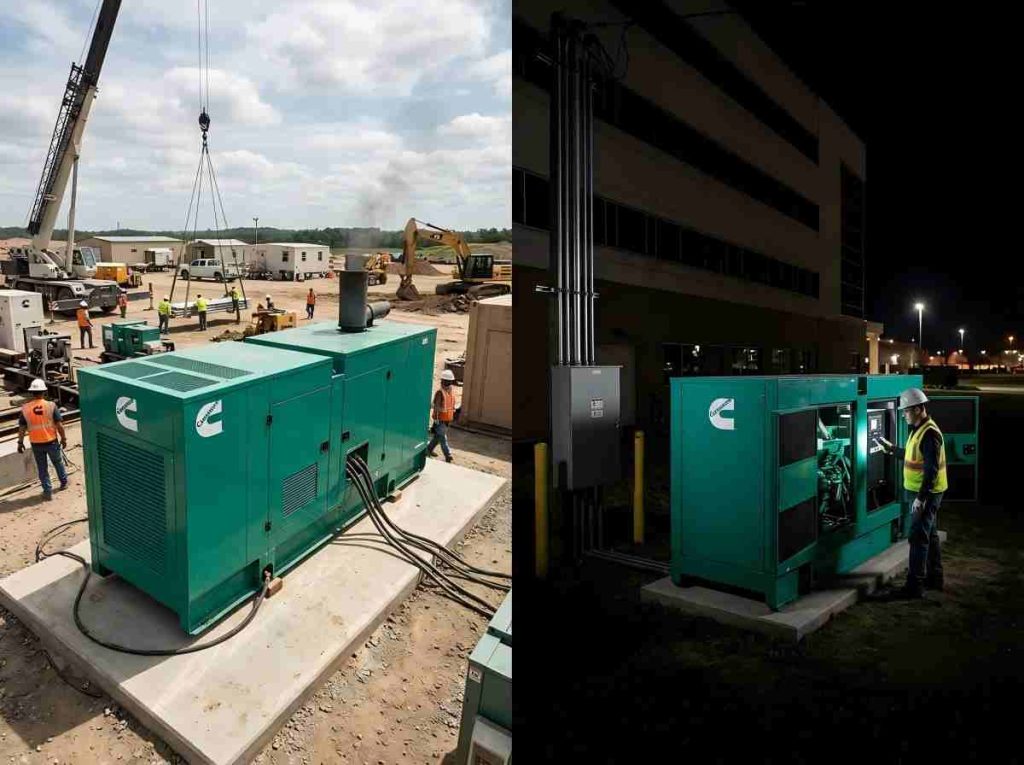
This is the rating you’ll see specified for construction sites, mining operations, remote telecom towers, and any location without reliable grid access. If a job site is running a generator as its everyday power source, prime is almost always the correct starting point, not standby.
Prime vs Standby: Key Differences at a Glance
| Standby (ESP) | Prime (PRP) | |
| Annual run hours | Up to 200 hrs/year | Unlimited |
| Average load factor | Not specified, intermittent use | Max 70% of prime rating |
| Overload allowance | Typically none | 10% for 1 hr per 12 hrs, max 25 hrs/year |
| Typical setting | Grid backup | Sole power source |
| Common applications | Hospitals, data centers, commercial buildings | Construction sites, mining, remote/off-grid sites |
| Relative output on same engine | Higher kW rating | Lower kW rating |
The last row trips up a lot of first-time buyers: a generator’s standby number is always higher than its prime number, because standby duty is short and occasional, while prime duty demands the engine hold up under continuous, varying load for years. Comparing two quoted kW figures without checking which rating they refer to is one of the fastest ways to end up with the wrong machine.
How to Size a Cummins Generator Set
Once you know which duty cycle applies to your situation, sizing the unit itself follows a fairly consistent process.
Step 1: Calculate Total Load
Add up the running wattage of everything the generator needs to power at once — motors, HVAC, lighting, control systems, whatever applies to the site. For an existing facility, clamp meters on the main service panel during peak operation will give you real numbers rather than estimates. For a new build, this comes from the electrical load schedule.
Convert everything to kW, then to kVA using the power factor (more on that below), since generator sets are rated in kVA.
Step 2: Determine Operating Mode
This is where the prime-versus-standby decision from earlier feeds directly into the sizing math. A site pulling power from the grid 360 days a year and only needing backup during storms is a standby application — size against the standby rating. A site with no grid connection at all needs the prime rating, sized so the expected average load lands under that 70% ceiling, not right up against the full nameplate figure.
Step 3: Account for Power Factor and Starting Surge
Most equipment runs at a power factor somewhere around 0.8, meaning a generator rated at 100 kVA delivers roughly 80 kW of usable output — not 100 kW. Underestimating this gap is one of the more common sizing errors.
Motors and compressors also draw a starting surge that can run three to six times their running current for a second or two. If a site has large motor loads starting up, the generator needs enough surge capacity to cover that spike without the voltage sagging or the engine stalling. This is usually the deciding factor between two generator sizes that otherwise look close on paper.
Step 4: Match to the Right Cummins Generator Set
With load, duty cycle, and surge requirements worked out, the last step is matching those numbers to an actual unit. A standard open-type genset suits most fixed installations. Sites with noise restrictions — near residential areas or indoor facilities — need a silent/soundproof enclosure instead. Outdoor sites exposed to weather call for a rainproof canopy, and jobs that move between locations, like construction projects or event power, are better served by a trailer-mounted set that can be towed as needed.
Getting the enclosure type wrong doesn’t affect the electrical output, but it does affect maintenance access, noise compliance, and how long the unit lasts outdoors — so it’s worth treating as part of the sizing conversation, not an afterthought.
Common Generator Sizing Mistakes
A generator running consistently under 30% load builds up unburned fuel and soot in the exhaust, a problem commonly called wet stacking, which reduces efficiency over time and can damage the engine. Oversizing “just to be safe” often causes this exact issue.
On the other end, undersizing — usually from skipping the starting surge calculation — leads to voltage drops, tripped breakers, and in some cases premature engine failure from being run past its rated capacity. Both mistakes come from the same root cause: sizing off theoretical maximum demand instead of the actual load profile of the site.