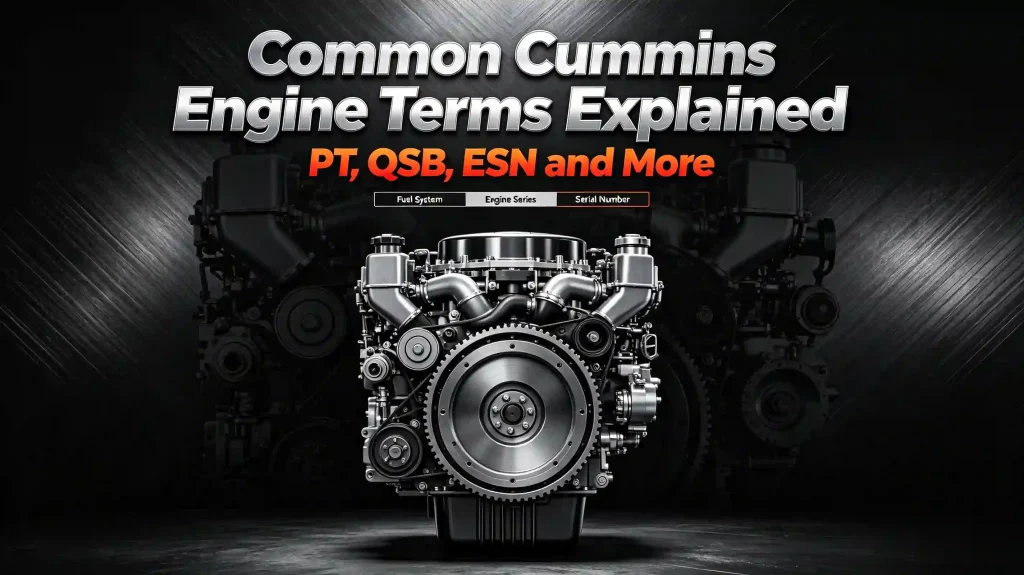
Common Cummins Engine Terms Explained: PT, QSB, ESN and More
If you work with Cummins engines, you will often see terms such as PT fuel system, QSB, ESN, CPL, HPCR, rpm, and kW. They show up in engine manuals, parts catalogs, nameplates, service documents, and even everyday conversations between technicians and parts suppliers.
For experienced diesel engine technicians, most of these terms are already familiar. But if you are new to Cummins engines, sourcing replacement parts, or trying to identify an engine, it can be difficult to tell what each abbreviation actually means.
You do not need to know every Cummins term by heart. A basic understanding of the ones you see most often can make it much easier to read engine information, identify the right parts, and explain an engine problem to a technician or supplier.
Below, we have put together some of the most common Cummins engine terms and abbreviations, along with simple explanations of what they mean and where they are used.
1. Cummins Engine Series and Model Terms
Cummins has produced a wide range of diesel engines for trucks, construction equipment, generators, marine applications, and other industrial uses. The engine name usually contains a combination of letters and numbers, such as 6BT, NT855, QSB6.7, QSL9, or QSK60.
The letters generally identify the engine family or series, while the numbers can provide information about displacement or the particular engine configuration. However, the naming system is not simply a direct indication of engine power, so it is better to check the specific model data rather than trying to calculate power from the model name alone.
6BT
The 6BT is part of the well-known Cummins B Series. The “6” indicates the number of cylinders, while “BT” identifies the engine family and configuration. Different versions of the 6BT have been used in vehicles, equipment, and other applications.
NT855
NT855 is a member of the older Cummins NT Series. It is a six-cylinder engine with a displacement of about 14 liters and has been widely used in heavy-duty and industrial applications.
QSB6.7
QSB6.7 belongs to the Cummins B Series and has a 6.7-liter displacement. The QSB family is commonly found in construction equipment, agricultural machinery, industrial equipment, and generator applications.
You may also see names such as QSL9 and QSK series. These are different Cummins engine families designed for different power ranges and applications.
When checking parts, the complete engine model is more useful than simply knowing that an engine is a “B Series” or “QSK.”
2. Fuel System Terms
Fuel system terminology is particularly important when you are dealing with Cummins engine parts. A fuel pump, injector, or related component may look similar across different engines, but it does not mean the parts are interchangeable.
PT Fuel System
PT stands for Pressure-Time. The Cummins PT fuel system controls the amount of fuel delivered to the engine by controlling fuel pressure and the time available for fuel delivery.
PT systems were widely used on earlier Cummins diesel engines. You may see terms such as PT fuel pump, PT injector, PT pump, or PT fuel system when searching for parts for older Cummins engines.
If you are working on an engine equipped with a PT system, identifying the exact engine model and fuel system is important before ordering replacement components.
Fuel Injector
A fuel injector delivers fuel into the engine cylinder at the required time and in the required amount. Its design depends on the engine and fuel system.
For this reason, simply searching for a “Cummins injector” is usually not enough when buying a replacement. The engine model, injector number, and other identification information should be checked first.
Common Rail / HPCR
Newer Cummins engines may use Common Rail fuel systems. You may also see HPCR, meaning High Pressure Common Rail.
Unlike a traditional PT system, a common rail system stores fuel at high pressure in a common rail and uses electronically controlled injectors to deliver fuel to the cylinders.
The two systems work differently, so PT components and common rail components should not be treated as interchangeable parts.
3. Engine Identification and Basic Parameters
If you are ordering parts or asking for technical support, engine identification is often the first thing a supplier will ask for.
ESN
ESN means Engine Serial Number. It is a unique identification number assigned to an individual engine.
The ESN is important because two engines with similar model names may have different specifications, components, or production configurations. When checking parts, providing the ESN can help identify the correct engine configuration.
You can normally find the engine identification information on the engine data plate or nameplate. If you are unsure which part you need, providing a clear photo of the nameplate can also make the identification process easier.
CPL
CPL stands for Control Parts List. It is used to identify a particular engine configuration and the key components associated with it.
You may see the CPL number mentioned when discussing Cummins engine parts, rebuild specifications, or engine configuration.
For some parts, the ESN and CPL together provide useful information for confirming compatibility, especially when an engine has several possible configurations.
HP and kW
HP means horsepower, while kW means kilowatts. Both are used to describe engine power.
You may see engine specifications listed in either unit depending on the market or application. Generator sets, for example, commonly use kW and kVA, while engine and vehicle specifications may also use horsepower.
rpm
rpm means revolutions per minute. It describes how fast the engine crankshaft is turning.
For example, an engine specification may show a rated speed of 1,800 rpm. This is particularly important for generator applications because engine speed is closely related to the generator’s operating frequency.
4. Common Repair and Parts Terms
When talking about Cummins repairs, you will encounter many component names that are not specific to one engine series but are frequently used in parts catalogs and repair discussions.
Overhaul Kit
An overhaul kit usually contains a selection of parts needed when rebuilding an engine. Depending on the engine and kit, it may include items such as piston rings, gaskets, bearings, and other engine components.
The exact contents vary, so it is important to check the kit’s part numbers and application before ordering.
Gasket and Seal
Gaskets and seals are used to prevent oil, coolant, fuel, or combustion gases from leaking between components.
During an engine overhaul, these parts are often replaced rather than reused. Terms such as gasket set, overhaul gasket kit, oil seal, and valve cover gasket are common in parts searches.
Filter
Cummins engines commonly use oil filters, fuel filters, and air filters as part of their routine maintenance.
Although filters are relatively simple maintenance parts, the correct filter still needs to match the engine and application. Part numbers and engine identification should be checked before purchasing.
Thermostat
The thermostat controls coolant flow according to engine temperature. It helps the engine reach and maintain its normal operating temperature.
A faulty thermostat can affect engine temperature and cooling system performance, so it is another common replacement part during maintenance and repair.
Why These Terms Matter When Buying Parts
Understanding Cummins terminology becomes especially useful when you need to identify or order a replacement part. Simply asking for a “Cummins fuel injector,” for example, is usually not enough to determine the correct part. Providing the engine model, ESN, CPL, existing part number, or a clear photo of the engine nameplate gives a parts supplier much more information to work with.
This is particularly important with older engines, as different configurations may use different fuel systems or component numbers. In most cases, the engine nameplate and ESN are a good place to start. Once the engine is properly identified, details such as the model, CPL, fuel system, and applicable part numbers can be checked more accurately.
For customers sourcing Cummins engine parts, Longshine can help identify the required components based on engine information and part numbers, making it easier to find the right parts for maintenance and repair. Knowing common terms such as PT, QSB, ESN, CPL, HPCR, kW, and rpm also makes communication with a parts supplier more straightforward.